The Need for Ajax
In Part I, "A Refresher on Web Technologies," we reviewed the core technologies that form the components of an Ajax application. By now, you will hopefully have at least a rudimentary knowledge of JavaScript, PHP, and XML, all of which we'll use here in Part II.
Before discussing the individual components, let's look in more detail at what we want from our Ajax application.
Traditional Versus Ajax Client-Server Interactions
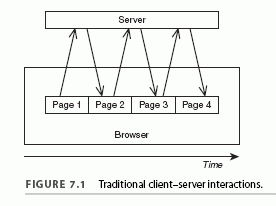
Lesson 1, "Anatomy of a Website," discussed the traditional page-based model of a website user interface. When you interact with such a website, individual pages containing text, images, data entry forms, and so forth are presented one at a time. Each page must be dealt with individually before navigating to the next.
For instance, you may complete the data entry fields of a form, editing and re-editing your entries as much as you want, knowing that the data will not be sent to the server until the form is finally submitted.
Figure 7.1 illustrates this interaction.